
Blog
What if learning challenges start before the lesson does?
Many of the skills children rely on in the classroom are rooted in their motor development. But what happens when those foundations are not yet fully developed? The Motor Skills Report 2025 highlights why motor development deserves a more prominent place in education.
The role of motor skills in the classroom
We ask a lot of children at school. They need to sit upright, learn to write, concentrate, control their movements and actively engage in lessons. We often take these abilities for granted. Yet many of them depend on a solid foundation of motor skills. When that foundation is less well developed, everyday classroom activities can become more demanding. This raises an important question: should motor development play a more explicit role in how we think about the quality of primary education?
What we expect from children and what we may overlook
Many classroom skills depend on underlying motor abilities. Maintaining a stable posture at a desk, controlling movements, writing by hand and staying seated and focused for longer periods all require children to coordinate their bodies effectively.
These abilities develop over time. And not every child develops them at the same pace.
Motor development cannot be taken for granted
The Motor Skills Report 2025 shows a clear relationship between motor competence and children’s participation in sports, outdoor play and their enjoyment of physical activity. Children with stronger motor skills tend to be more physically active and participate more often.
At the same time, longitudinal research by Koolwijk shows that positive motor development is not a given. Nearly one in five young children follows an unfavourable motor development trajectory.
In other words, differences in motor development can emerge early and they do not necessarily disappear as children get older.
How motor skills affect the classroom
Balance, coordination and postural control all contribute to how children function at school. They support the physical demands of sitting and working at a desk, handwriting, fine motor tasks and many other everyday classroom activities.
When these underlying skills are still developing, tasks that appear relatively simple may require considerably more effort.
That matters because a child who has to devote more attention and energy to maintaining posture or controlling a pencil has fewer resources available for the task itself.
Motor development cannot be taken for granted’
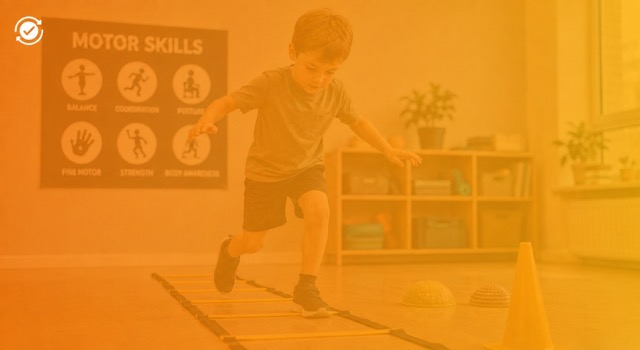
A cycle that can reinforce itself
Children with poorer motor skills often participate less in physical activities. This gives them fewer opportunities to practice and develop those skills, which can cause differences between children to increase over time.
The impact may extend beyond physical activity alone. Motor development can influence how easily and confidently children participate in everyday activities, including those at school.
What does this mean for education?
Motor development is not just a matter of sport or physical health. It is also relevant to children’s participation in education and to creating equal opportunities for every child to develop.
For schools, this raises a practical question: how can we systematically monitor children’s motor development and use those insights to provide the right support?
Without a clear picture of each child’s development, support can easily remain broad and generic. Yet differences between children often call for a more targeted approach.
A total of 1,154 primary schools have already placed greater emphasis on motor development. Thanks in part to their participation, the Motor Skills Report 2025 provides valuable insight into motor development among children across the Netherlands and shows where the greatest differences occur.
Explore the full Motor Skills Report 2025.
Will your school make motor development a priority in the new school year?
Start MQ Scan Now!
Request free information for your school.
Terms & Policies
Contact
Address:
Hendrik Figeeweg 1C
2031 BJ Haarlem
The Netherlands
Recent Comments