
Blog
From the Netherlands to Spain: the MQ Scan crosses borders
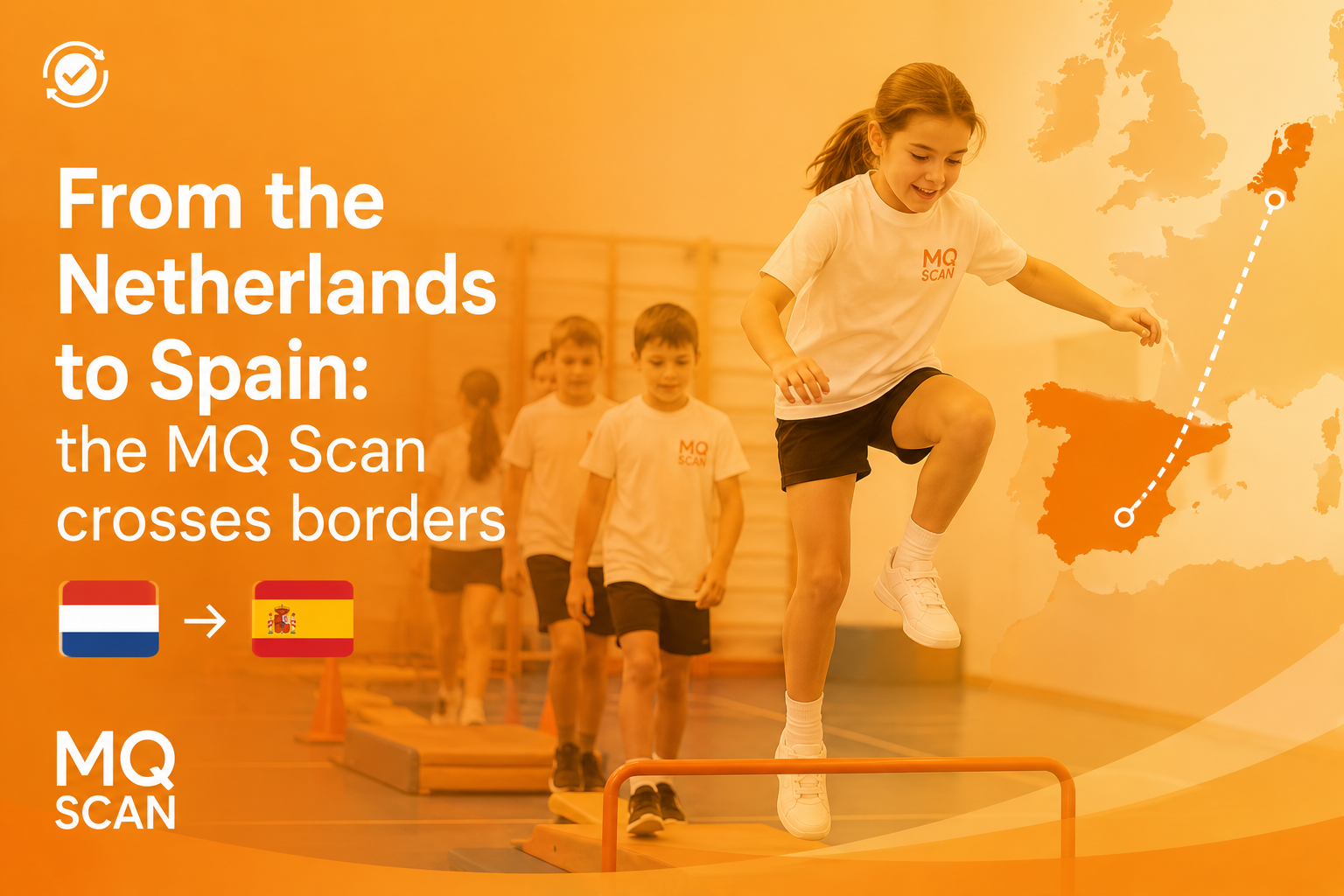
What started as a practical motor skills assessment for Dutch PE classes is now crossing borders. Spanish researchers have applied the Athletic Skills Track, the scientific foundation of the MQ Scan, to more than 1,250 children. And they took it one step further: based on the results, they established their own Spanish reference values.
An exciting international step for a method that started with a relatively simple question: how can we assess children’s motor competence in a way that is both reliable and practical?
From Dutch PE classes to Spain
The foundation of the MQ Scan was developed by researchers from The Hague University of Applied Sciences and Vrije Universiteit Amsterdam. Their aim was to develop a motor competence assessment that was not only scientifically sound, but also practical enough to assess an entire class within a single PE lesson. This resulted in three age-specific obstacle courses, the Athletic Skills Tracks (AST). Children perform a range of fundamental movement skills, including walking, jumping, crawling, balancing and climbing.
Today, this methodology is attracting attention beyond the Netherlands. Researchers from the University of Castilla-La Mancha and The Hague University of Applied Sciences investigated whether the existing Dutch reference values could also be used for Spanish children. A total of 1,257 children aged 5 to 12 from seven schools in Castilla-La Mancha completed the Athletic Skills Track. Based on their performance, the researchers established Spanish reference values by age and gender. This means that a motor skills assessment originally developed in the Netherlands now has its own reference values in another national context.
The same assessment, different performance
These Spanish reference values reveal some interesting findings. First, there are differences between boys and girls. On AST-1, used with the youngest children, the researchers found no significant differences. On AST-2, boys aged 6 to 9 were significantly faster than girls. On AST-3, this was the case for children aged 9, 10 and 11. No significant difference was found among 12-year-olds. This highlights why age- and gender-specific reference values are relevant when assessing children’s motor competence. But things become even more interesting when the Spanish results are compared with the existing Dutch reference values.
Dutch children perform better than Spanish children
The Dutch children included in the comparison completed the Athletic Skills Tracks significantly faster than the Spanish children. Interestingly, the Spanish children in the study actually received more compulsory physical education: three 45-minute PE lessons per week, compared with two 45-minute lessons in the Dutch context. More PE time alone therefore does not appear to explain the difference. The researchers therefore also consider what happens outside PE lessons.
Previous research suggests that Dutch children are, on average, more physically active than Spanish children and that differences in BMI and overweight exist between the two populations. Since higher levels of physical activity are associated with greater motor competence, while higher body weight is negatively associated with motor competence, the researchers identify these factors as possible explanations.
There is, however, an important caveat. Sports participation, daily physical activity, height, weight and BMI were not measured among the children in this study. We therefore cannot conclude that these factors caused the differences. Instead, the researchers identify them as relevant areas for future research.
‘Dutch children perform better than Spanish children’
Start MQ Scan Now!
Request free information for your school.
Terms & Policies
Contact
Address:
Hendrik Figeeweg 1C
2031 BJ Haarlem
The Netherlands
Recent Comments